
BY: admin
Uncategorized
Comments: No Comments
What is a Sensory Diet?
What is a Sensory Diet?
Felicia Sexton, Occupational Therapist, Change for Life
As we go about our daily life, we are continually surrounded by a buffet of sensory input. Whether working in a brightly-lit office or simply walking down a crowed street, our lives are filled with sensations. The different types of sensory input can the broken down into seven senses: auditory (sound), visual (sight), taste (oral), touch (tactile), smell (olfactory), proprioceptive (body awareness), and vestibular (balance and movement). The first five are the most common senses that we know and use. Proprioceptive input is any activity that provides pressure to joints and muscles. Anytime we squeeze through a tight space, hold something heavy, hug someone or jump up and down we are receiving proprioceptive input.
The way our brain processes the sensory information we receive from the world around us, can impact how we go about our day. Even though we may experience each of the senses throughout the day, just like with food, everyone has unique preferences for certain types of sensory input. We may start the day with a cold shower to wake us up, or perhaps position our desk to be in bright light or a quieter spot, maybe even go out of our way to avoid certain strong smells. These preferences can be referred to as a sensory profile and can be used to create a sensory diet. A sensory diet refers to the type and amount of sensory input a person needs in order to function throughout their day at an optimal level. Sometimes without even knowing it, we all have ways of meeting out our individual sensory needs. For example, after sitting for a long time, we may find ourselves tapping a leg or flicking a pen (increasing tactile or movement input). Some people may chew on a pencil when feeling stressed or drink a cup of tea to help them relax. There are countless sensory strategies that can be used to help us stay alert when feeling tired, or alternatively, calm us down when feeling agitated, stressed or just needing to relax.
One thing that is important to note, is that there is no right or wrong sensory profile or diet. Similar to one person preferring sweet foods and another person preferring savoury; a sensory profile is just a part of what makes us individuals. Knowing our own personal sensory preferences can help us pick strategies that keep us working at our best.
For children, it can sometimes be challenging knowing what sort of sensory inputs match their sensory needs. This is especially the case when it comes to sensory information they have never experienced before. Some sensory information can be overwhelming; bright lights, loud noises, strong tastes or even certain smells might become distressing if they fill up a child’s sensory needs too quickly. Alternatively, a child might actively seek out colourful toys, things that make fun sounds, certain food or smells they find appealing. Helping a child explore their sensory needs can help them develop good sensory strategies and allow them to better engage with daily activities, both at home and in the community.
Knowing what type of sensory input a child might find alerting, exciting, calming or relaxing, means that those sensory inputs can be used to create effective sensory strategies. Potentially decluttering a visually stimulating desk or listening to calming music, might help a child concentrate. Some children may prefer more active sensory inputs, such as taking a break from tasks to bounce on a trampoline or do star jumps. The key to a beneficial sensory diet is to find that “optimum sensorimotor input” a child needs before, during, or after an activity to keep them going. Remembering, that for each child this is going to be different. Each sensory diet should be based on an individual child’s needs and preferences.
A sensory diet can include sensory input from any of the senses and often includes a list of activities that can help your child meet their own personal sensory needs. These activities can include sensory inputs that their body is craving/seeking or ones that help to keep their body calm (activities that helps them settle, focus and self regulate. Sensory strategies can also be used to address a child’s sensory tolerance or sensory sensitivities. For example, when a child becomes upset during grooming, picky eating and other sensory behaviour. By using sensory strategies and a sensory diet, it can help your child to function at their highest potential and participate more fully in their daily life activities.
If you are interested in finding out more about your child’s individual sensory profile and sensory diet, you can contact an occupational therapist for help with developing strategies and supports for both you and your child.
BY: admin
Uncategorized
Comments: No Comments
The Non-Diet Approach – Weight Loss Is Not The Answer.
The Non-Diet Approach – Weight Loss Is Not The Answer.
Kimberly Nelson, Dietitian, Change for Life
Weight loss counselling (essentially dieting) is the traditional treatment modality that Dietitians are trained in, despite flaws in the evidence base and evidence demonstrating that it is ineffective and can cause more harm than good. Research shows that dieting is almost synonymous with weight regain within 2-5 years (NHMRC, 2013; Mann et al, 2007). The Non-Diet approach (essentially weight neutral counselling) does not refute the associations between health and a higher weight but queries the causative factors driving them. A systematic review of 16 studies by Clifford et al (2015) demonstrated that a weight neutral approach resulted in weight stability at 5 years, improved biochemical markers, sustained healthy behaviours and improved psychological outcomes such as self-esteem, disordered eating and depression. Most importantly there were no negative outcomes.
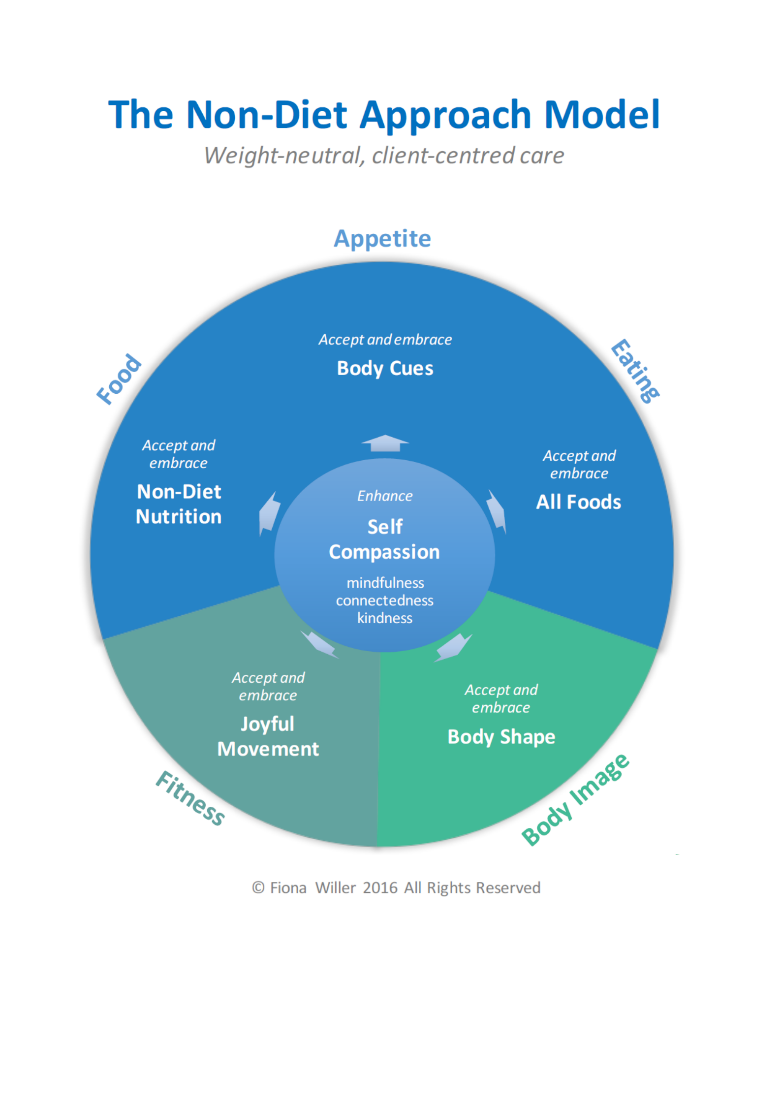
The Non-Diet Approach is a paradigm based on the principles of Health at Every Size® (HAES®), which rejects the focus of weight as a determinant of health and sees it as a consequence of numerous factors affecting an individual’s health. It accepts and respects the natural diversity of body shapes and sizes; values eating in a flexible way by listening to our body’s internal cues; and moving for enjoyment rather than a desire to be thin. The Non-Diet Approach is the model of Dietetic practice of HAES®. It’s 5 core principles are grounded in accepting and embracing – body cues, all foods, body shape, joyful movement and non-diet nutrition to enhance self-compassion (see model below). Healthy behaviours like being physically active, eating the recommended serves of fruit and vegetables and having higher self-compassion, have more of an influence on a person’s health than their weight (Clifford et al, 2015). By taking this weight neutral approach with our patients and treating people with a BMI above the ‘healthy’ range the same as those considered to have a healthy BMI, we can reduce our own weight bias and improve our ability to actually help those who are stigmatised for being in a larger body.
BY: admin
Uncategorized
Comments: No Comments
Two-year-old children: what to look out for
Two-year-old children: what to look out for
An important question parents ask is what their two-year-old child should be saying or how they should be interacting with other children in their age group. Children from bilingual families can differentiate their languages as young as two years of age, and possibly earlier. In terms of developmental milestones, research suggests that there is no outstanding difference between bilinguals and monolinguals, when the learning opportunities for both languages are taken into account. Read More “Two-year-old children: what to look out for”
BY: admin
Uncategorized
Comments: No Comments
How to get kids to eat more veggies
How to get kids to eat more veggies
Have mealtimes become increasingly stressful in your household? Are your children refusing to eat vegetables or try new foods? Fussy eating amongst toddlers and young children is relatively common. Below are 10 tips to get your kids eating more vegetables and trying new foods. Read More “How to get kids to eat more veggies”
BY: admin
Uncategorized
Comments: No Comments
Happy Parents: Happy Teens
Happy Parents: Happy Teens
One of the commonly seen problems in teenage years is the changes in mood and emotions. As the brain is changing rapidly, teenagers can be prone to feeling low and finding their world confusing. One risk of being depressed as a teenager is that there is a risk of experiencing greater levels of depression as an adult. An important factor that can help teens develop resilience is to model resilient behaviour from their parents. Adolescents whose parents have depression can be more prone to depression in adulthood compared to teenagers whose parents have healthy mental health. Growing research shows that the mental health of mothers plays an important role in how much adolescents improve when they get stressed and depressed. Similarly, the role of fathers can be very important in understanding how depressed mood develops and how severe it can get in adolescents. Read More “Happy Parents: Happy Teens”
BY: admin
Uncategorized
Comments: No Comments
What is Occupational Therapy?
What is Occupational Therapy?
As a Paediatric Occupational Therapist, we get asked all the time what it is that we really do! Lots of parents are often confused about what occupational therapy (OT) really is. So, let me sum it up in a nutshell for you. Occupational therapists help children take part in every area of their life to the best of their ability. For kids, this usually means playing, school, family, and self-care (such as toileting, feeding and dressing). For a child to take part in these activities they need concentration, coordination, motor skills, perceptual skills, and the ability to keep their mind and body calm and focussed so they can learn. Our goal is to help children to become more independent and skilled in these areas. Read More “What is Occupational Therapy?”
BY: admin
Uncategorized
Comments: No Comments
Healthy Eating During the School Holidays
Healthy Eating During the School Holidays
Keeping everyone busy and entertained during the summer holidays can be a challenge. Making sure everyone is maintaining a healthy diet can be even more challenging. When the kids are on holidays, routines and schedules change and healthy eating is suddenly not a priority. This can lead to eating higher amounts of discretionary “junk” foods which a high in calories, sugar, unhealthy fats and salt. Read More “Healthy Eating During the School Holidays”
BY: admin
Uncategorized
Comments: No Comments
Iron Requirements for Children & Adolescents: The Invisible “Mr. I”
Iron Requirements for Children & Adolescents: The Invisible “Mr. I”
“Mr. I”, as we tell children sometimes, or iron is one of the invisible minerals in your child’s diet. Iron is associated with strength and Mr. Ironman is no doubt considered quite the superhero for being super strong. What is iron and why do we need it, is a question many parents ask. Iron is an essential mineral that has many important functions. It helps to carry oxygen around our body and gives us energy. We also need iron to support our immune system, support muscle function, and assist with cognitive functioning. Unfortunately, iron deficiency is quite common, even in developed countries such as Australia. Not having enough iron can make you feel both mentally and physically tired. Read More “Iron Requirements for Children & Adolescents: The Invisible “Mr. I””
BY: admin
Uncategorized
Comments: No Comments
How to Talk and Listen to Kids When They Need Help
How to Talk and Listen to Kids When They Need Help
Parents can be the first to notice when their child or teen is struggling and needs support. One of the most important things is to build trust with your child that they can turn to you to communicate their feelings and be heard. Just like with adults, we do not want to talk to anyone unless we feel comfortable, kids will turn to those who make them feel its ok to talk and share their feelings. When children turn to you for support or have questions it is really important to listen and allow them to solve their problems rather than overload them with solutions and opinions that can feel helpful but obstruct the teen or child from building problem solving processes and working through to their own solutions. Read More “How to Talk and Listen to Kids When They Need Help”
BY: admin
Uncategorized
Comments: No Comments
Helping babies communicate: what to look for at 12 months
Helping babies communicate: what to look for at 12 months
Are you concerned about your child’s language and communication? Don’t use the “wait and see” principle. There is help and support to kick start the children’s development and give them the help they need in time. Learning for a child begins from the second they are born. Language is an essential part of your baby’s development. Babies use skills like listening to others, recognising different sounds and talking as a way to start recognising language and responding the world around them. The first step for babies is to understand what they hear and then progress to start talking and using sounds in different ways. Read More “Helping babies communicate: what to look for at 12 months”