
BY: admin
Uncategorized
Comments: No Comments
The Non-Diet Approach – Weight Loss Is Not The Answer.
The Non-Diet Approach – Weight Loss Is Not The Answer.
Kimberly Nelson, Dietitian, Change for Life
Weight loss counselling (essentially dieting) is the traditional treatment modality that Dietitians are trained in, despite flaws in the evidence base and evidence demonstrating that it is ineffective and can cause more harm than good. Research shows that dieting is almost synonymous with weight regain within 2-5 years (NHMRC, 2013; Mann et al, 2007). The Non-Diet approach (essentially weight neutral counselling) does not refute the associations between health and a higher weight but queries the causative factors driving them. A systematic review of 16 studies by Clifford et al (2015) demonstrated that a weight neutral approach resulted in weight stability at 5 years, improved biochemical markers, sustained healthy behaviours and improved psychological outcomes such as self-esteem, disordered eating and depression. Most importantly there were no negative outcomes.
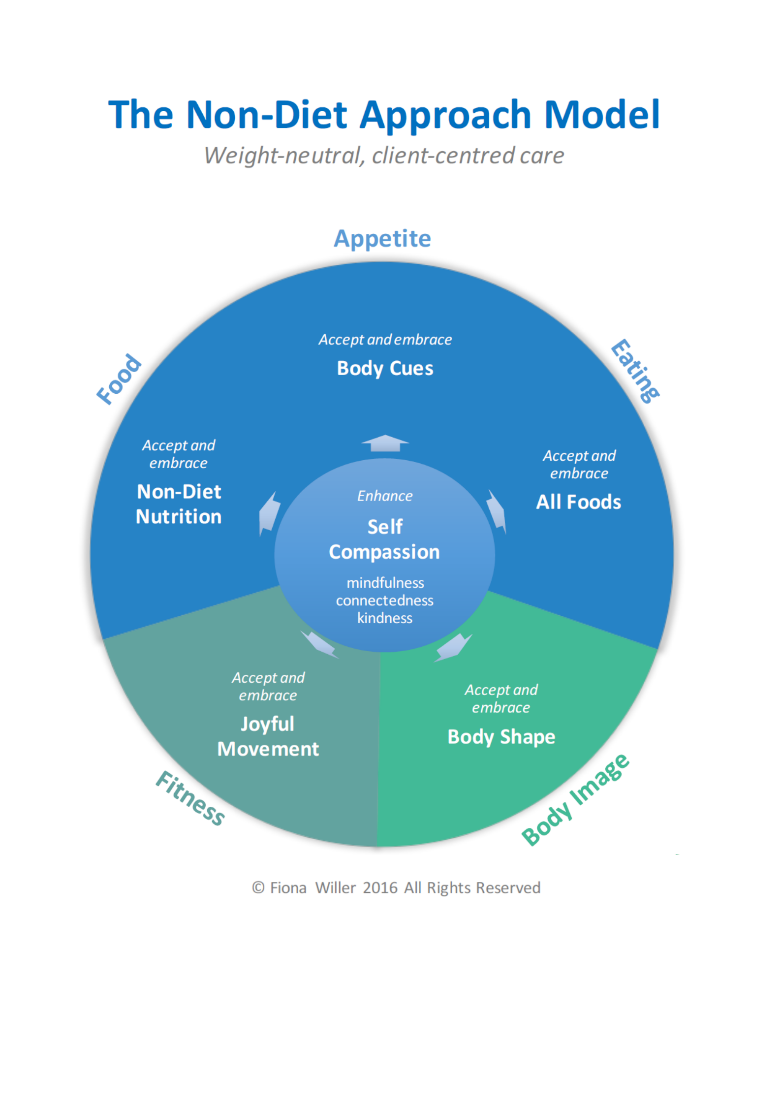
The Non-Diet Approach is a paradigm based on the principles of Health at Every Size® (HAES®), which rejects the focus of weight as a determinant of health and sees it as a consequence of numerous factors affecting an individual’s health. It accepts and respects the natural diversity of body shapes and sizes; values eating in a flexible way by listening to our body’s internal cues; and moving for enjoyment rather than a desire to be thin. The Non-Diet Approach is the model of Dietetic practice of HAES®. It’s 5 core principles are grounded in accepting and embracing – body cues, all foods, body shape, joyful movement and non-diet nutrition to enhance self-compassion (see model below). Healthy behaviours like being physically active, eating the recommended serves of fruit and vegetables and having higher self-compassion, have more of an influence on a person’s health than their weight (Clifford et al, 2015). By taking this weight neutral approach with our patients and treating people with a BMI above the ‘healthy’ range the same as those considered to have a healthy BMI, we can reduce our own weight bias and improve our ability to actually help those who are stigmatised for being in a larger body.
BY: admin
Calcium
Comments: No Comments
Memory In Young Kids: Helping with Learning and Attention in Learning
Memory In Young Kids: Helping with Learning and Attention in Learning
Dr. Malini Singh, Psychologist, Change for Life
Being able to focus and pay attention is important for learning and holding one’s attention. This is important in three ways. First, your child has to pay attention to take the information in. Secondly, the information has to move to the part of the brain that retains the information and add to long-term memory. Lastly, the information has to be recalled, so that it can be remembered at the right time. Many children struggle with these processes and it can be difficult to know where the difficulties lie for each child. A few tips can help in improving children’s school grades and in learning new tasks.
Read More “Memory In Young Kids: Helping with Learning and Attention in Learning”
BY: admin
Calcium
Comments: No Comments
Calcium requirements for children
Calcium requirements for children
Dr Malini Singh
Calcium is a nutrient that we hear about quite often. Most commonly, it’s associated with strong bones and teeth and in the prevention of osteoporosis in old age. Calcium is also very important in the proper functioning of our heart, nerves and muscles. Read More “Calcium requirements for children”
BY: admin
Psychologist
Comments: No Comments
Helping Healthy Technology Use for Teens
Helping Healthy Technology Use for Teens
Dr. Malini Singh, Psychologist, Change for Life
Today’s teenagers live in a high-tech world. Most have their own tablet, smart phone, and access lots of online resources for school and to connect to their friends. Regulating your teenager’s screen time may seem like a constant battle, and parents worry about the effect of technology on their teenager’s physical and mental health. Read More “Helping Healthy Technology Use for Teens”
BY: admin
Psychologist
Comments: No Comments
Starting Prep: A Whole New World
Starting Prep: A Whole New World
Dr Malini Singh, Psychologist, Change for Life
Yes!! It’s that time when you have just finished buying your first school uniform and cannot believe your toddler is now ready for the big world called school. It is an unforgettable moment to see one’s child in their uniform and arrive at school for the first day. All the photographs and proud moments are shared with friends and family. School is such big change for families and children. There are lots of new rules and challenges for a child used to the open spaces and learning environment of kindergarten. Read More “Starting Prep: A Whole New World”
BY: admin
Occupational Therapist
Comments: No Comments
Why all the talk about the W-sit?
Why all the talk about the W-sit?
Rachael Thomas, Change for Life, Occupational Therapist
While developing motor skills, play skills, and independence, children move and change their body’s position all the time. One of the many positions you may find your child sitting in is a W-sit position, which is often referred to as “W-sitting”. This position was awarded its name because it involves a child bending their legs at the knees and spreading out from their hips to make a W shape. While many typically developing children move through this position from time to time during play, excessive use of this position is strongly discouraged and can result in challenges further down the track.
BY: admin
Uncategorized
Comments: No Comments
Two-year-old children: what to look out for
Two-year-old children: what to look out for
An important question parents ask is what their two-year-old child should be saying or how they should be interacting with other children in their age group. Children from bilingual families can differentiate their languages as young as two years of age, and possibly earlier. In terms of developmental milestones, research suggests that there is no outstanding difference between bilinguals and monolinguals, when the learning opportunities for both languages are taken into account. Read More “Two-year-old children: what to look out for”
BY: admin
Uncategorized
Comments: No Comments
How to get kids to eat more veggies
How to get kids to eat more veggies
Have mealtimes become increasingly stressful in your household? Are your children refusing to eat vegetables or try new foods? Fussy eating amongst toddlers and young children is relatively common. Below are 10 tips to get your kids eating more vegetables and trying new foods. Read More “How to get kids to eat more veggies”
BY: admin
Uncategorized
Comments: No Comments
Happy Parents: Happy Teens
Happy Parents: Happy Teens
One of the commonly seen problems in teenage years is the changes in mood and emotions. As the brain is changing rapidly, teenagers can be prone to feeling low and finding their world confusing. One risk of being depressed as a teenager is that there is a risk of experiencing greater levels of depression as an adult. An important factor that can help teens develop resilience is to model resilient behaviour from their parents. Adolescents whose parents have depression can be more prone to depression in adulthood compared to teenagers whose parents have healthy mental health. Growing research shows that the mental health of mothers plays an important role in how much adolescents improve when they get stressed and depressed. Similarly, the role of fathers can be very important in understanding how depressed mood develops and how severe it can get in adolescents. Read More “Happy Parents: Happy Teens”
BY: admin
Uncategorized
Comments: No Comments
What is Occupational Therapy?
What is Occupational Therapy?
As a Paediatric Occupational Therapist, we get asked all the time what it is that we really do! Lots of parents are often confused about what occupational therapy (OT) really is. So, let me sum it up in a nutshell for you. Occupational therapists help children take part in every area of their life to the best of their ability. For kids, this usually means playing, school, family, and self-care (such as toileting, feeding and dressing). For a child to take part in these activities they need concentration, coordination, motor skills, perceptual skills, and the ability to keep their mind and body calm and focussed so they can learn. Our goal is to help children to become more independent and skilled in these areas. Read More “What is Occupational Therapy?”