
BY: admin
Uncategorized
Comments: No Comments
The Maze of Dementia Care: A Glimpse into A Daughter’s Life

When I first got told my mother had dementia and was terminally I was about 16 years old with very little idea of what that meant. It was 35 years or so ago and we have very little information about it compared to what we have today. And I lived in a small town in India where we didn’t have the access to computers or the Internet like we do now! So, it was a journey that not only shaped my life in many many ways to be the person I am today but also understand that this condition wasn’t so much about one person- it affected everyone around it. In my case, my family, parent’s relationship, our friends, my mother’s job, and my schooling at the time. In fact, it has taken me decades to write about it and share my thoughts such as this blog, as this personal journey has been one of the most powerful ones for me as a carer in my late teens and till I was about 23 years old, when we lost my mother to this condition, at the age of approx 56.
What has inspired me to write is that it is a simple way of reaching out to others who may be on this position and although everybody has a different experience we can all hold hands to share our support as this can change the whole course of how one lives through a very confusing and emotionally charged journey.We do have so much information now and can find all these posts and blogs and support groups, it can be an information overload and one has to think about how to find information that is relevant to you and your situation to make small decisions about yourself and how you are travelling in that space. This emotional rollercoaster can be shared by talking to your counsellor, a support group where you may have some good connections, and connecting to what is happening around you. I feel especially proud of Im part of Dementia Awareness Week and sharing this with everyone whom it may help or inspire. This week has a special meaning for me- not just because it helps me to focus on the topic that I relegate to the side in the busyness of life, but also because it connects me to my journey and allows me to reflect on my memories and experiences in new ways that bring a sense of positivity to my life. It is an oasis in the desert of fear and anxiety if you are a carer. It has been struggle (and you can relate to that if you have been in these shoes in any way), that one cannot see much positivity in a condition that can lead to such deterioration and loss. At least, I did not and have often thought why we still have these conditions when Man has reached the Moon? It inspired me to study further in Neuroscience and has fostered a life long passion for understanding how to work with our neural networks (no brain, no me as far as I can see).
This week I want to share the message that this too shall pass. Looking back, I did not often see that apart from a sense of how to get through the day and try to see what the planning needed to be like. Thats mostly all I did and there were new things to contend with as we progressed through the maze. I went to a birthday celebration at a nursing home for advanced dementia residents at the request of the family and what struck me was the sense that they could celebrate and share the memories of beautiful family moments. The family visited every day in turns and it became quite a focal point of their daily life. When the time came for them to stop visiting, I was very moved by their comments to continue to visit the nursing home and help others with meals and outings as they had made these incredible connections through their time there.
My physical journey as a carer has passed and many of the memories have receded in my mind, but as I go down memory lane (and I feel fortunate that I am able to do that, more so now having been a carer than ever before and I am ageing with my own fears) the emotional journey is ongoing in new ways. I want to share that sense of appreciation of the gift of knowing who people are around me, sharing the small joys with my family, and building memories for the future. I could not have had that deep personal experience without the experience of deeply understanding what it could be like without that ability. For that alone, I am grateful to my experiences as being a child who looked after their parent with dementia. Although mama you may not have known who I was physically towards the end, the love and the connection will never end. What one cannot hear in words one can feel through a million other ways (the way your eyes lit up when you saw me or a big grin when I said something silly which you always found funny) and that can never be taken away from you or me and my message to everyone here today reading this about the person you love.
Here are some links to help support people caring for loved ones with Dementia:
Nationwide, 24-hour carer support | Dementia Support Australia
BY: admin
Uncategorized
Comments: No Comments
Persuasive Letters for Perspective Taking
Persuasive Letters for Perspective Taking.
Michael Audas – Speech Pathology.
 Writing a persuasive letter can be a fun way to encourage children to think about the perspectives and motivations of others. In order to convince someone, you need to think about a person’s personality traits, desires, beliefs, and circumstances.
Ordinarily, persuasive writing tasks in school are addressed to a generic audience (e.g., a classroom cohort), but a persuasive letter is addressed to a particular person. This means that one has to think deeply about that person in order to select, and then word, the points of argument that will persuade them to adopt a particular position, or to undertake a particular action.
Books with rich, vibrant characters—such as classic fairytales—are a great way to kick off this exercise. Children can select their favourite character from the story, take on their perspective, and then write a letter to persuade another character from the story. For example, Rapunzel’s father might write a letter to the Witch, pleading for his daughter’s release, or The Big Bad Wolf might write an apology letter to Little Red Riding Hood, and attempt to convince her that their unfortunate history was really just a big misunderstanding.
The following is a helpful checklist to run through with children in order to keep them on track, and to check whether their letter is sufficiently persuasive:
[ ]Includes sender’s address[ ]Includes an opening sentence that hooks the reader[ ]Includes an introduction, paragraphs explaining a point each and a conclusion[ ]Each point has an explanation and evidence to support it[ ]Includes emotive language, such as “Everyone would ecstatic if…”[ ]Includes rhetorical questions, such as “Are we supposed to just sit back…?”[ ]Includes exaggeration, such as “It would be a tragedy if…”[ ]Includes flattery, such as “I’ sure that you have already noticed…”[ ]Includes a conclusion that summarises the main point and reiterates the opinion[ ]Finishes with “Yours faithfully” if you don’t know the recipient or “Yours sincerely” if you do know the recipient.
BY: admin
Uncategorized
Comments: No Comments
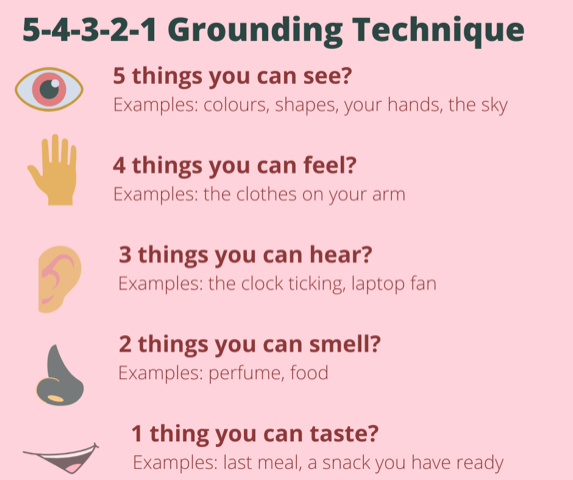
The 5-4-3-2-1 Grounding Technique
The 5-4-3-2-1 Grounding Technique
Stephanie Cordingley – Psychologist
The 5-4-3-2-1 grounding technique helps to you to reconnect and refocus on the here and now (the present moment) by tuning into your five senses. The technique is useful when you find yourself feeling very overwhelmed. It only takes a few minutes and can be practiced at any time.
BY: admin
Uncategorized
Comments: No Comments
School Holiday Activity
School Holiday Activity!
Rachael Downing – Speech Allied Health Assistant
During these school holidays it can be a great activity to make rainbows with fruit or crafts!
This can help build your children’s language surrounding colours and their fine motor skills!


BY: admin
Uncategorized
Comments: No Comments
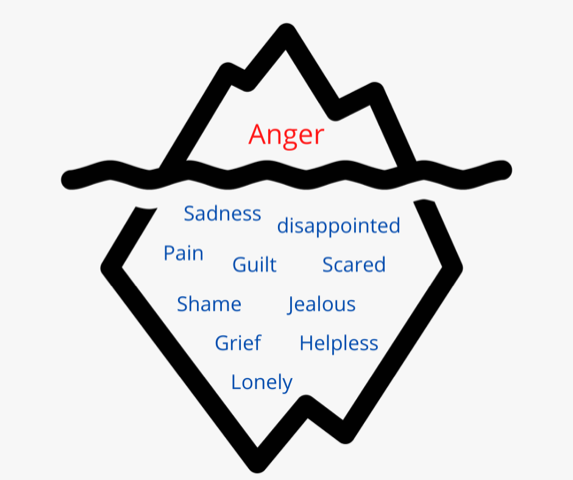
Iceberg
Iceberg
Stephanie Cordingley – Psychologist
BY: admin
Uncategorized
Comments: No Comments
The Plurivocality of ’the Dreaming’
The Plurivocality of ’the Dreaming’
Michael Audas – Speech Pathology
Considering the richness of Indigenous Australian language and tradition for reconciliation week
’Plurivocal’ is a seldom-used word in the English language meaning “many voiced.” Despite it being seldom used, it is nevertheless a useful concept for capturing terms which find their expression through a multitude of inter- related words—as distinct from a word that has many different meanings. The Dreaming, or Dreamtime, is referred to by different words in different Indigenous languages. In East Arnhem Land, for instance, it is referred to as Wongar; Altjeringa, by the Arrernte people; and Bugari in Broome. None of these words are strictly synonymous, as they each foreground certain con- stituent elements of the Dreaming, whilst in no way excluding those elements which are less strongly emphasised.
Let us touch on just a few of these elements by way of illustration. The first element is perhaps the one that the broader Australian culture is per- haps more familiar with: the mythological1 narratives about the foundation of the created order by the ancestors. The second element concerns the con- centration and crystallisation of spiritual power in certain geographical sites, and in certain plants and animals. The third element governs social, moral, ritual, and sacramental life. A fourth element appertains to the individual; specifically, their vocation or calling, as determined by clan membership, spiritual virtues, or connection to particular sites (Charlesworth et al., 1984) . With some luck, it is perhaps already apparent how each of the preceding elements is, at one in the same time, distinct as well as interconnected: the
1’Mythology’ here is not used in the pejorative sense of something which belongs to the order of fiction or mere imagination. Cf. Ananda Coomaraswamy:
The myth is the penultimate truth of which all experience is the temporal reflection. The mythical narrative is of timeless and placeless validity, true nowhereandeverywhere… Mythembodiesthenearestapproachtoabsolute truth that can be stated in words. (Coomaraswamy, 2011)
role of the ancestors in shaping the cosmos is causally connected to the spir- itual power of certain sites, while the configuration of the society is vital to the discovery and flourishing of the individual’s vocation which in turn allows him or her to commune through the sacred sites and with the ancestors.
The above outline is, of course, grossly oversimplified for the sake of brevity and schematisation of what is, in reality, a system of rites, codes, art, and myth vast enough to encompass both created and uncreated realities. The Dreaming in fact connects these realities, inasmuch as establishes that the created order is a reflection, or manifestation of the uncreated order, while also functioning as a bridge from the former to the latter. One of the ways in which it does this is to by imparting a kind of lexicon of the land, wherein the symbolic correspondence of natural places, objects, flora, and fauna with the spiritual realm of the Dreaming can be understood. In the same way that, in order for us to be able to read a book, we require knowledge of the symbol system (language) being employed, in order to understand what objects, occurrences, and so forth are being referred to by the symbols contained in the book, being able to read the land also requires knowledge its symbol system. On this view, the land itself is a holy scripture.
Recommended books to explore Dreamtime myths with children:
Luurnpa, the Magical Kingfisher

This is a traditional Dreaming narrative, belonging to Bai Bai Napan- garti from the Balgo Hills region of Western Australia. It tells the story of Luurnpa, who saves the Kukatja people from dying of thirst by showing them his magic rock hole full of water. For many years the Kukatja people lived on land where there was plenty of water. But then a drought came and the people cried out for Luurnpa, the magical kingfisher to help them.
The Rainbow Serpent

A timeless classic from the Dreamtime. there are innumerable names and stories associated with the Rainbow Serpent, all of which communicate the significance of this being within Aboriginal traditions. Dreamtime stories tell how the Rainbow Serpent came from beneath the ground and created huge ridges, mountains and gorges as it pushed upward. the name also reflects the snake-like meandering of water across a landscape and the colour spectrum sometimes caused by sunlight hitting the water. Paintings of the Rainbow Serpent first appeared in Arnhem Land rock art more than 6000 years ago, and perhaps as early as 8000 years before the present, as the seas rose after the last Ice Age. today the Rainbow Serpent is associated with ceremonies about fertility and abundance, as well as the organisation of the community and the keeping of peace.
References
Charlesworth, M., Morphy, H., Bell, D., & Maddock, K. (1984). Religion in aboriginal australia: an anthology. University of Queensland Press.
Coomaraswamy, A. K. (2011). Hinduism and buddhism. Golden Elixir Press.
BY: admin
Uncategorized
Comments: No Comments
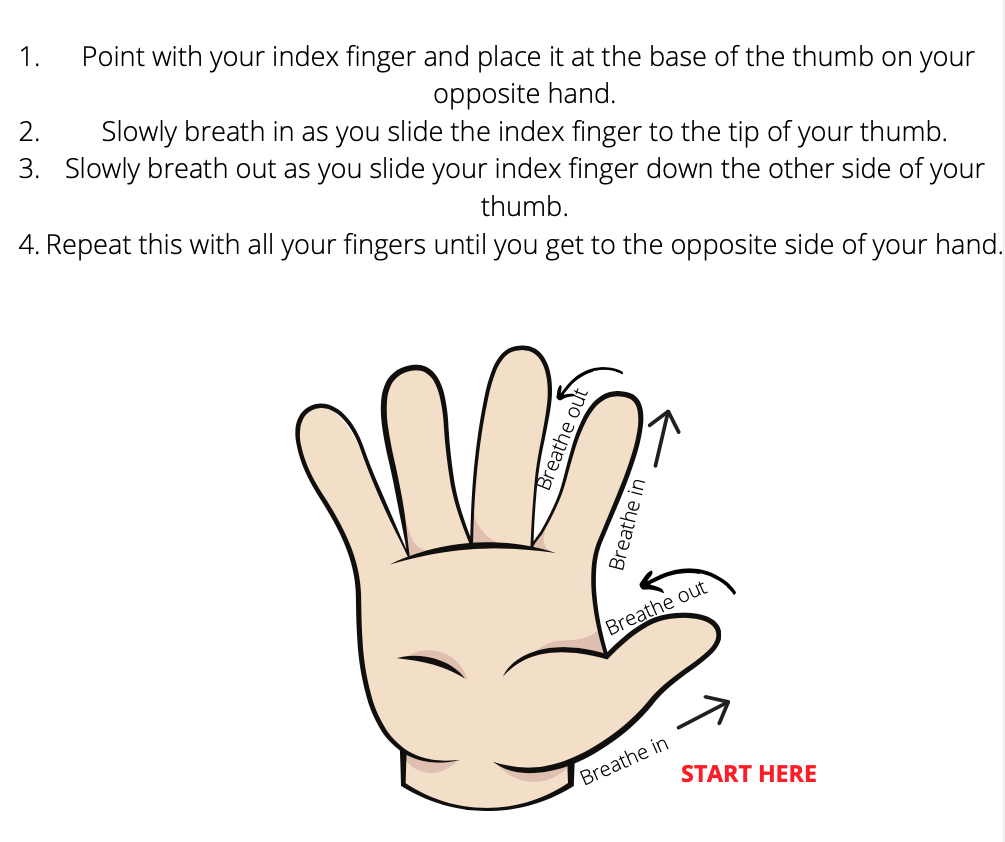
Breathe In
Breath In
Stephanie Cordingley – Psychology
It’s important for children to know that all feelings are ok. So, the aim of the exercise is to allow our child to calm down so that they can talk about their big feelings with us. We want them to understand that they should not avoid or feel ashamed for having big feelings.
A simple breathing exercise that is empowering for children is the five-finger breathing technique. With practice, it can be performed anytime and anywhere. Practicing this technique regularly means that breathing deeply will come naturally when it’s needed.
BY: admin
Uncategorized
Comments: No Comments
How a Mood Tracker is helpful
How a Mood Tracker is helpful
Melanie Chan – Psychologist
- identify patterns and understand changes in mood
- develop different strategies to manage low moods
- determine if our strategies and intervention are helping us improve our mood


BY: admin
Uncategorized
Comments: No Comments
Using Bubbles for Language Development
Using bubbles for language development.
Rachael Downing – Allied Health Assistant.

Bubbles can be a great tool for language development!
They can provide lots of opportunities for developing both nonverbal and verbal communication.
For instance, they can promote your child to learn:
- Eye contact
- Turn taking
- Create opportunities to use signs.
Bubbles can also create the opportunity for:
- Your child learning to request.
- Teaching new sounds such as /p/
- Teaching new words such as bubble or pop.
- Teaching your child to round their lips.
Remember bubbles can be used for all different ages and stages to promote language development. You can also use bubbles to describe and talk about them. For example: big, small, tiny, sticky, wet.
BY: admin
Uncategorized
Comments: No Comments
Recognising the signs of anxiety
Recognising the signs of anxiety.
Stephanie Cordingley – Psychologist

Sometimes children will show signs of anxiety, worries and fear, this is a normal part of development. If you’re concerned that your child’s fears, worries, or anxiety are affecting their health and happiness speak with your GP or a health professional.
Children often communicate that they are feeling anxiety in less obvious ways than just lots of expressed worrying. Recognising the signs of anxiety can help us better support and respond when they are going through a rough time. See the pie chart for some examples of how anxiety may be expressed.